Beyond the Cloud: Why Edge AI is the Next Frontier for Computer Engineers

In the last five years, Artificial Intelligence has been defined by the “Cloud.” We send our prompts to ChatGPT, our photos to Google, and our voice commands to Alexa—all of which travel to massive data centers thousands of miles away. But a quiet revolution is happening right under our noses, and for Computer Engineers, it’s the most exciting shift in a decade: Edge AI (or TinyML).
What is Edge AI?
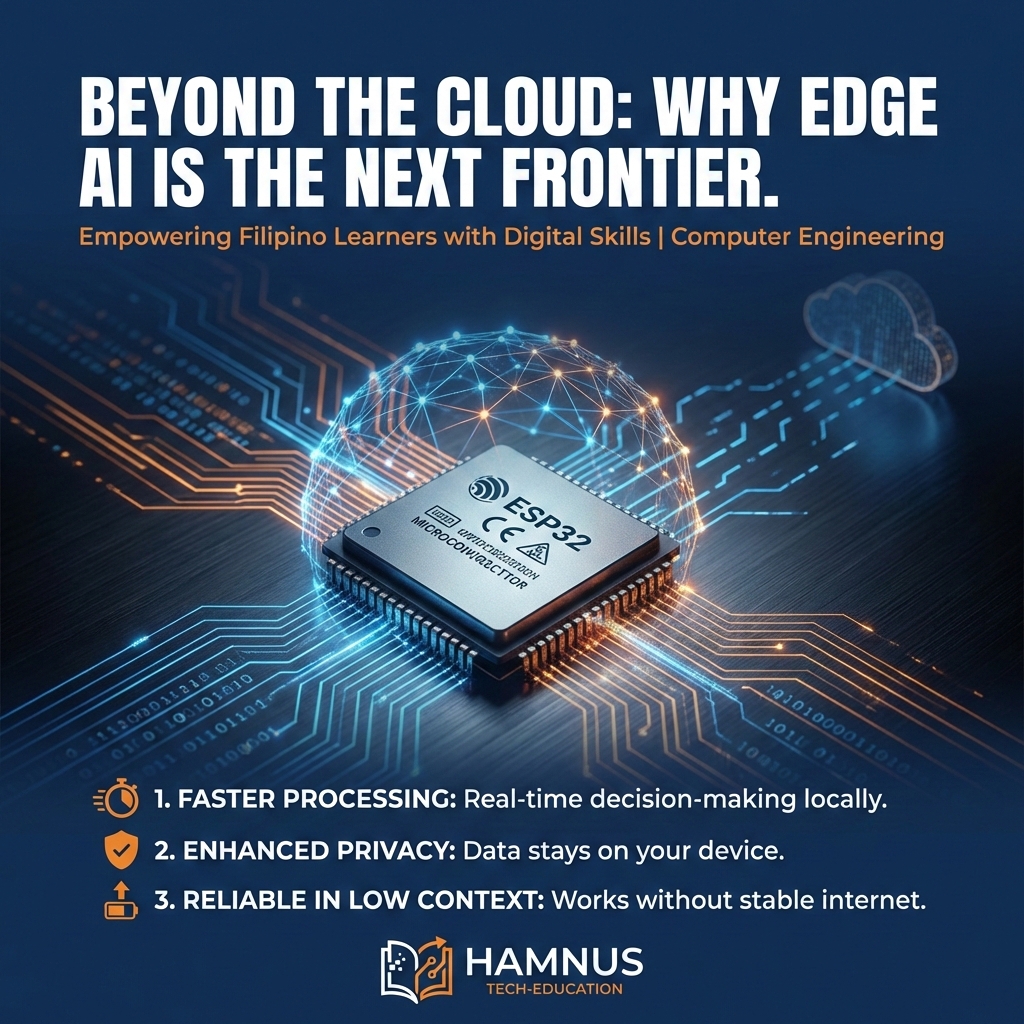
Edge AI is the practice of running machine learning models directly on local devices—like your smartphone, a wearable health monitor, or even a $5 microcontroller like the ESP32—without needing an internet connection. Instead of sending data to a server and waiting for a response (latency), the device “thinks” for itself.
Why This Matters for the Philippines
For us in the Philippines, Edge AI isn’t just a “cool feature”; it’s a necessity. Here’s why:
- Internet Reliability: We all know the struggle of unstable connections. An Edge AI-powered agricultural sensor can detect crop diseases in a remote farm in Isabela even if there is zero bars of LTE.
- Latency: For real-time applications like self-driving delivery drones or industrial robots, waiting 500ms for a cloud response is too slow. Edge AI happens in milliseconds.
- Privacy: Data never leaves the device. For medical devices or home security, this ensures that sensitive information stays private.
The Hardware-Software Convergence
As Computer Engineers, we sit at the intersection of bits and atoms. Edge AI is the ultimate manifestation of this. To master it, you need to understand both sides:
The Software: You aren’t running massive 175-billion parameter models. You are working with “quantized” models—optimized versions of AI that can fit into 256KB of RAM. Tools like TensorFlow Lite for Microcontrollers and Edge Impulse are leading the way.
The Hardware: New chips are being designed specifically for this. From the NPUs (Neural Processing Units) in the latest iPhones to specialized AI accelerators in microcontrollers, the hardware is evolving to handle matrix multiplication at ultra-low power.
Getting Started: Your First Project
Want to build something? You don’t need a $2,000 GPU. Here is a simple path:
- Pick a Board: Start with an ESP32-CAM or an Arduino Nano 33 BLE Sense.
- Use Edge Impulse: This is a fantastic platform that simplifies the process of collecting data and training a model for small devices.
- The Goal: Try “Keyword Spotting” (making an LED turn on when you say a specific word) or “Gesture Recognition” (detecting if you are shaking or tilting the device).
The future of AI isn’t just in the giant data centers of Silicon Valley. It’s in our pockets, on our wrists, and embedded in the world around us. For the next generation of Filipino engineers, the “Edge” is where the real innovation begins.