
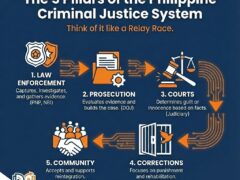
So, What Exactly Is the Criminal Justice System?
Think of it like a relay race. When a crime happens, different teams take turns handling the situation until justice is served. In the Philippines, we call these teams the “Five Pillars” – and understanding how they pass the baton to each other is basically Criminology 101.
Let us break it down in a way that actually makes sense.
The Five Pillars: Your Quick Overview
Before we dive deep, here is the lineup:
- Law Enforcement – The ones who catch the bad guys
- Prosecution – The ones who build the case
- Courts – The ones who decide guilty or not
- Corrections – The ones who handle punishment and rehabilitation
- Community – That is you, me, and everyone else
Now let us see what each one actually does.
Pillar 1: Law Enforcement – The First Responders
Who Are They?
The most visible pillar. When something goes wrong, these are the people you call:
- PNP (Philippine National Police) – Your everyday police officers handling most crimes
- NBI (National Bureau of Investigation) – Think of them as the “big case” specialists
- PDEA – Focused specifically on drug-related crimes
- Other agencies – Coast Guard, Customs, Immigration, each with their specialty
What Do They Actually Do?
Their job is pretty straightforward:
- Respond when crimes happen
- Investigate what went down
- Gather evidence (witnesses, documents, physical evidence)
- Catch and arrest suspects
- Prepare everything for the next pillar
The Catch
Here is the thing – law enforcement can only do so much. They can arrest someone, but they cannot decide if that person is guilty. That is not their job. Once they have done their part, they hand everything over to…
Pillar 2: Prosecution – The Case Builders
Who Are They?
Prosecutors work under the Department of Justice. They are the lawyers who represent the government – basically, they represent all of us, the Filipino people.
What Do They Actually Do?
When police hand over a case, prosecutors ask one crucial question: “Is there enough evidence to take this to court?”
Their tasks include:
- Preliminary Investigation – Reviewing if the evidence is solid
- Filing Charges – Officially accusing someone in court
- Trying the Case – Presenting evidence and arguing why the accused is guilty
The Inquest: A Special Situation
Ever heard of “inquest”? It happens when someone is arrested without a warrant (like being caught in the act). The inquest prosecutor has to quickly decide: Was this arrest legal? Should we file charges or let them go?
Why This Matters
A weak prosecution means criminals walk free even when police did their job. The prosecutor is the bridge between catching someone and actually convicting them.
Pillar 3: Courts – Where Decisions Are Made
The Court Hierarchy (From Bottom to Top)
First Level: MTC/MeTC (Municipal/Metropolitan Trial Courts)
- Handles minor cases
- Small claims, less serious crimes
Second Level: RTC (Regional Trial Courts)
- Serious criminal cases
- Can also review MTC decisions
Third Level: Court of Appeals
- Reviews RTC decisions
- When someone says “I will appeal!” – this is usually where it goes
Special Court: Sandiganbayan
- Specifically for cases involving government officials
- The anti-corruption court
Top Level: Supreme Court
- The final word
- Their decision is THE decision
How a Trial Works (Simplified)
- Arraignment – “You are charged with X. How do you plead?”
- Pre-Trial – Both sides agree on what facts are not disputed
- Trial – Prosecution presents evidence, then defense responds
- Decision – Judge decides: guilty or not guilty
- Sentencing – If guilty, what is the punishment?
The Key Principle
Courts operate on “presumption of innocence” – you are innocent until proven guilty. The prosecution must prove guilt beyond reasonable doubt. If there is reasonable doubt, the accused walks free.
Pillar 4: Corrections – Beyond Punishment
It Is Not Just About Locking People Up
Contrary to what movies show, corrections is not just about throwing people in jail. The goal is actually rehabilitation – helping offenders become productive members of society again.
Who Handles What?
BuCor (Bureau of Corrections)
- Manages national prisons
- For those sentenced to MORE than 3 years
- Facilities like New Bilibid Prison
BJMP (Bureau of Jail Management and Penology)
- Manages city and municipal jails
- For those awaiting trial OR sentenced to 3 years or less
Parole and Probation Administration
- Supervises people released early for good behavior
- Monitors probationers (those given a chance to avoid jail)
Rehabilitation Programs
Modern corrections includes:
- Education programs (many inmates earn degrees while inside)
- Skills training (carpentry, welding, farming)
- Counseling and therapy
- Religious programs
- Good Conduct Time Allowance (GCTA) – behave well, get out earlier
The Reality Check
Philippine jails are overcrowded. Some facilities hold 5 times their intended capacity. This is a major challenge that affects rehabilitation efforts.
Pillar 5: Community – Yes, That Includes You
Why Is Community a Pillar?
Here is something many people miss: the criminal justice system cannot work without community participation. You are not just a bystander – you are part of the system.
How the Community Participates
- Reporting crimes – If nobody reports, nobody gets caught
- Being witnesses – Your testimony can make or break a case
- Barangay justice – Minor disputes get settled at the community level first
- Accepting reformed offenders – Reintegration only works if society accepts them back
The Barangay Justice System (Katarungang Pambarangay)
For minor disputes between neighbors, you cannot just run to court. You need to go through barangay conciliation first. The Punong Barangay and the Lupong Tagapamayapa try to settle things peacefully.
This keeps small conflicts from clogging up the courts and maintains harmony in communities.
How It All Connects: A Crime From Start to Finish
Let us trace a hypothetical case:
- Crime happens – Someone’s phone gets snatched
- Community – Victim reports to police, witnesses provide descriptions
- Law Enforcement – Police investigate, identify suspect, make arrest
- Prosecution – Prosecutor reviews evidence, files robbery charges
- Courts – Trial happens, judge finds accused guilty
- Corrections – Offender serves sentence, joins rehabilitation programs
- Community (again) – After release, community accepts reformed individual
See how each pillar depends on the others? If any pillar fails, the whole system weakens.
Current Challenges: The Honest Truth
The system is not perfect. Here is what criminology students should know:
Case Backlog
Courts have thousands of pending cases. Some people wait years for their trial.
Jail Congestion
Facilities designed for 500 sometimes hold 2,500. This affects everything from health to rehabilitation.
Resource Limitations
Not enough prosecutors, public defenders, jail officers, or rehabilitation specialists.
The “Haves” vs “Have-Nots”
Those who can afford good lawyers often get better outcomes. The system tries to provide public attorneys, but they are overworked.
Why This Matters for Your Career
As a future criminology professional, you might work in any of these pillars:
- Law Enforcement – Police officer, NBI agent, crime scene investigator
- Prosecution Support – Legal researcher, paralegal
- Courts – Court personnel, stenographer
- Corrections – Corrections officer, probation officer, rehabilitation specialist
- Community – Social worker, victim advocate, crime prevention specialist
Understanding the whole system makes you effective no matter which pillar you join.
Board Exam Tip
For the Criminology Licensure Exam, remember:
- Know the specific agencies and their mandates
- Understand the flow from one pillar to the next
- Be familiar with key laws: RA 6975 (PNP), RA 10575 (BuCor), Rules of Court
- Focus on how pillars interconnect, not just what each does individually
The Bottom Line
The Philippine Criminal Justice System is like a chain – only as strong as its weakest link. Each pillar has its role, but none can work alone.
As a criminology student, your job is not just to memorize these pillars but to understand how they create a system that (ideally) delivers justice for all Filipinos.
And who knows? Maybe you will be part of making that system better.
This explainer is part of the Criminology series at Hamnus, designed to make complex legal concepts accessible for Filipino students.