The Elephant in the Room: AI in 2026
Let’s be real, mga Kasama. By now, everyone knows about ChatGPT, Gemini, and Claude. In 2025-2026, using AI isn’t “new” anymore—it’s normal. But there is a huge difference between a student who uses AI to learn faster and a student who uses AI to avoid learning.
If you just copy-paste your prompt and submit the output as your essay or code, you aren’t “hacking the system.” You’re cheating your future self. When you get to the technical interview for that high-paying developer job, ChatGPT won’t be there to whisper the answer in your ear.
But if you use AI correctly? It’s like having a personal tutor available 24/7. Here is the ultimate guide on how to use AI as a Super-Study Buddy in the Philippine education setting.
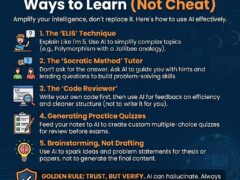
1. The “ELI5” Technique (Explain Like I’m 5)
Struggling with a complex concept like Polymorphism in OOP or Thermodynamics? Textbooks can be boring and hard to digest. Use AI to break it down.
Wrong Prompt: “Write an essay about Polymorphism.” (This is plagiarism/lazy)
Right Prompt: “I am a computer engineering student. Explain the concept of Polymorphism in Java using a ‘Jollibee’ analogy. Explain it like I’m 5 years old.”
Why it works: It forces the AI to simplify the logic into terms you already understand. Once you get the concept, then read the textbook definitions.
2. The “Socratic Method” Tutor
Don’t ask AI for the answer. Ask it to help you find the answer. This is called the Socratic Method—teaching by asking questions.
Right Prompt: “I am trying to solve this differential equation problem [Insert Problem]. Don’t give me the answer. Instead, give me a hint about the first step and ask me a leading question to help me solve it myself.”
Why it works: You build the neural pathways in your brain needed for problem-solving. You actually learn.
3. The “Code Reviewer” (Not Code Writer)
For CpE and IT students, this is crucial. If you let AI write your code, you will fail your live coding exams.
Instead, write your code first. Even if it’s broken. Even if it’s spaghetti code. Then, feed it to the AI.
Right Prompt: “Here is my Python code for a calculator. It works, but it looks messy. Can you review it and suggest 3 specific ways to make it cleaner or more efficient? Explain why your suggestions are better.”
Why it works: You get feedback similar to what a Senior Developer would give you in a real job.
4. Generating Practice Quizzes
Review centers are expensive. AI is free (mostly). Before a major exam, feed your notes to the AI.
Right Prompt: “I have pasted my notes on ‘Data Structures’ below. Create a 10-item multiple-choice quiz based on this text. Don’t show the answers immediately. Show the questions first, and provide the answer key at the very bottom.”
5. Brainstorming, Not Drafting
Stuck on a thesis topic? Writer’s block for your reflection paper? Use AI to spark ideas, not to write the paper.
Right Prompt: “I need to propose a thesis topic related to IoT and Agriculture in the Philippines. Give me 10 unique problem statements that affect Filipino farmers that could be solved with a microcontroller-based system.”
The Golden Rule: Trust, but Verify
AI hallucinates. It lies with confidence. It can invent court cases (as some lawyers found out the hard way) or syntax that doesn’t exist.
Always double-check facts. If AI cites a law or a formula, check your textbook. Using AI requires more critical thinking, not less. You are the Editor-in-Chief; the AI is just the intern.
Final Thoughts
The students who will succeed in 2026 and beyond aren’t the ones who banned AI, nor the ones who let AI do everything. The winners will be the Centaurs—humans combined with AI—who use these tools to amplify their own intelligence rather than replace it.
Use it wisely, Hamnus fam! 🚀