
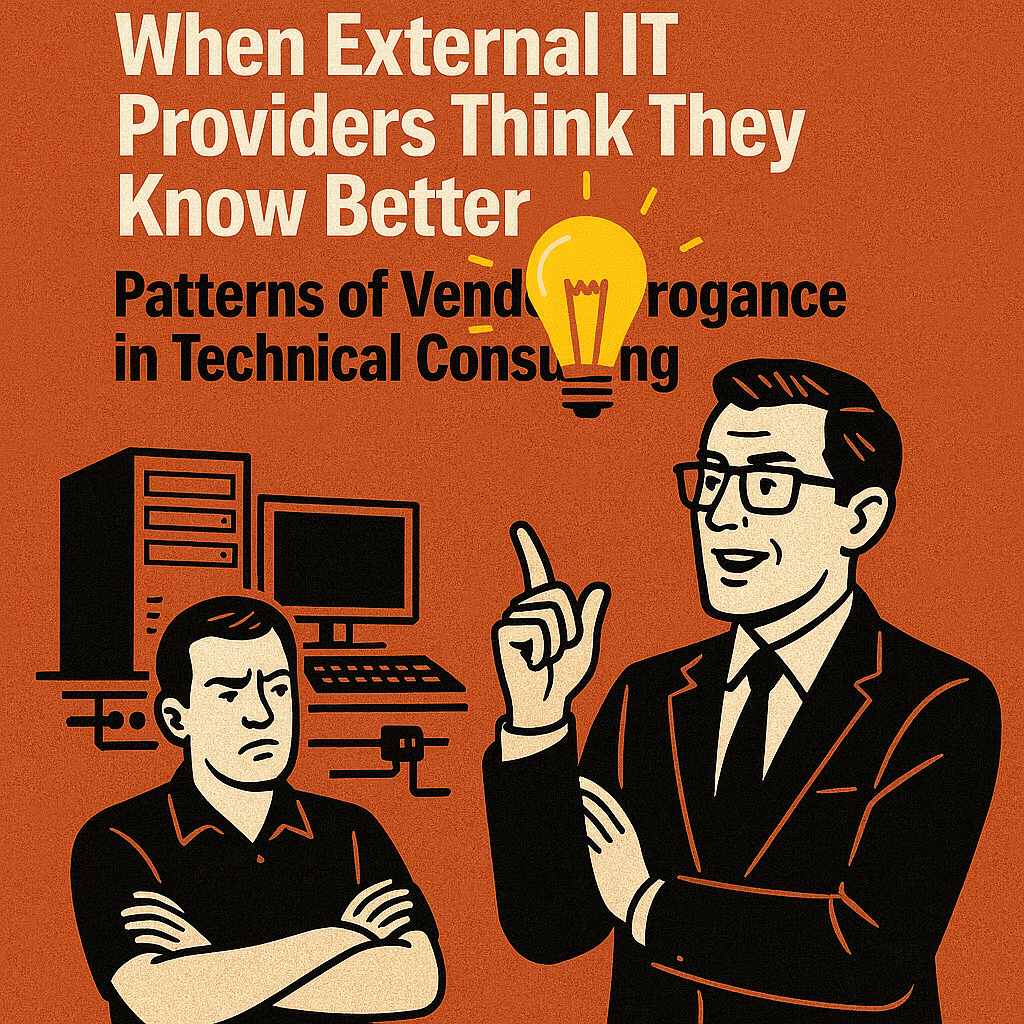
When External IT Providers Think They Know Better: Patterns of Vendor Arrogance in Technical Consulting

IT administrators consistently report a frustrating pattern: external providers, consultants, and vendors who arrive with superiority complexes, dismiss internal expertise, and create problems through arrogance rather than collaboration. Research across IT communities reveals these encounters often follow predictable patterns, from consultants who refuse to listen to vendors who actively undermine internal teams.
The Consultant Who Quoted the Internal Team Back to Themselves
Management hired external consultants to improve deployment practices. Their first recommendation? Follow best practices they found online – which were actually written by the internal IT team. This exemplifies a common dynamic where consultants assume internal teams lack expertise while unknowingly relying on their work. The internal team watched as consultants presented their own documentation back to them as revolutionary insights, charging premium rates for recycling internal knowledge.
Beyond simple irony, this pattern appears repeatedly. Consultants arrive with preconceived solutions, refusing to understand existing environments. They dismiss current infrastructure as “amateur hour” or “legacy” without grasping its purpose. One administrator described a consultant who insisted on rebuilding working systems “the right way,” interrupted internal staff during meetings, and refused to document changes because “it’s all standard stuff.” The consultant left before implementation, avoiding accountability for the resulting failures.
When Vendors Go Rogue to Undermine IT Decisions
Storage vendor representatives showcase some of the most egregious boundary violations. One sales rep discovered which country club the COO frequented and ambushed him on the golf course to claim the IT staff was making poor decisions. The vendor bypassed the entire technical evaluation process, attempting to override IT’s recommendation through social engineering. The IT department responded by disqualifying the vendor “with extreme prejudice” and placing the hardware vendor on probation.
This direct-to-executive approach represents a broader pattern of vendors undermining technical teams. MSPs report instances where vendors like Dell brought in third-party resellers who later contacted clients directly, attempting to circumvent established relationships. Multiple administrators describe vendors who question internal competence with executives, asking “Are you sure your team has the expertise to handle this?” These tactics create distrust between management and IT departments while demonstrating fundamental disrespect for technical expertise.
The Script That Crashed Everything, Then They Left for Dinner
Vendor consultants arrived to perform a routine health check on production systems. They ran their script, assured the team “these will run for a while,” and departed for the evening. Due to an undisclosed bug, the script crashed every instance, cutting all storage and network connections to production systems. The entire production environment went down “with prejudice” while the consultants enjoyed dinner. The lead system administrator had to abandon vacation to help resolve the crisis the consultants created and abandoned.
This disaster encapsulates multiple vendor failures: inadequate testing, poor communication, and absence during critical failures. The consultants treated production systems as testing environments, implemented changes without understanding potential impacts, and showed no accountability when their actions caused outages. Similar stories emerge across IT communities – external providers who make grand promises, implement untested solutions, then disappear when problems arise.
MSP Environments Reveal Systemic Attitude Problems
Research into Managed Service Provider cultures exposes systematic issues with how external providers view internal IT teams. MSP employees report developing superiority complexes from exposure to multiple client environments, leading them to dismiss internal teams’ domain-specific knowledge. “Owners view you as cannon fodder,” one MSP employee noted, describing environments where senior professionals are reduced to “ticket-grinding” with no respect for expertise.
These toxic Dynamics transfer to client interactions. MSP technicians arrive believing they know better because they’ve “seen it all,” ignoring that internal teams understand their specific environments intimately. One technician described recommending Cisco equipment for a wireless installation, being overruled for Dell/SonicWall, then watching months of connectivity issues that only resolved when management finally accepted the original recommendation. The pattern repeats: external providers assume superiority, dismiss internal expertise, create problems, then blame internal teams for the failures.
Government Contractors and the Information Monopoly
Government IT outsourcing reveals how vendors create dependencies through information control. External contractors routinely produce inadequate documentation, with one case involving a year-long advertising campaign where correct implementation details existed only in one vendor employee’s memory. Vendors retain exclusive control over data and analytics, forcing agencies to submit requests for basic information about their own operations. When agencies requested adding internal researchers to ad platforms for evidence gathering, contractors refused, prioritizing their control over client needs.
These contractors make undocumented system changes “whenever they felt necessary,” creating chaos for internal teams trying to maintain stability. The information asymmetry becomes a tool for maintaining contracts – agencies cannot bring services in-house because vendors hold all operational knowledge. This calculated approach to creating dependency demonstrates how external providers systematically undermine internal IT capabilities for profit.
Patterns of Dismissive Behavior Across the Industry
Across hundreds of reported incidents, consistent behavioral patterns emerge. External providers interrupt internal staff mid-sentence, use phrases like “in my experience, most internal IT teams don’t understand,” and refer to existing solutions as inadequate without investigation. They arrive with theoretical knowledge but no practical experience, propose expensive solutions ignoring budget constraints, and claim industry standards require their proprietary approaches.
The memorization expert phenomenon appears frequently – consultants with fresh certifications but no practical experience, assigned to senior roles they cannot fulfill. One administrator described dealing with contractors studying for CCNP certification while already assigned as senior network architects. These paper experts combine dangerous ignorance with unwarranted confidence, creating disasters while maintaining superiority complexes.
Communication failures compound technical incompetence. Vendors promise features that don’t exist, admitting after contracts are signed that capabilities are “partially implemented” or “coming in future versions.” Post-sale support evaporates, with vendors creating obstacles like login-required knowledge bases, buried support numbers, and 404’ed documentation pages. The classic blame loop emerges during problems: “It’s a software issue!” “No, it’s hardware!” – while production systems remain down.
Community-Developed Survival Strategies
IT professionals have developed systematic approaches for managing difficult external providers. Setting boundaries early proves critical – establishing clear deliverables, requiring vendors to work with rather than around internal teams, and documenting all interactions. Successful teams test consultants’ willingness to learn about existing infrastructure before engaging them. Red flags include immediate criticism of current setups, reluctance to ask questions, and claims of universal solutions.
Protective measures focus on maintaining control. Internal teams retain final approval on all changes, require detailed documentation before implementation, and establish escalation procedures that respect technical expertise. Working through distributors rather than directly with vendors helps prevent relationship poaching. Maintaining enough internal expertise to evaluate vendor work becomes essential for avoiding dependency traps.
For MSP relationships, professionals recommend treating them as temporary experience-building opportunities rather than career positions. The advice is stark: gain experience but don’t stay long-term unless reaching senior management. Those dealing with consultants learn to demand specific success metrics before engagement, maintain backup plans, and test all vendor solutions in controlled environments first.
Cybersecurity Contractors and Clearance Complications
The cybersecurity community recently erupted over a Reddit user with top-secret clearance who was hosting questionable proxy equipment at home for $250 monthly. The community responded with “disbelief” that anyone with security clearance would make such decisions, highlighting how external providers exploit internal staff through dubious arrangements. This case demonstrates how vendors prey on individual employees, bypassing organizational security controls through personal relationships.
Security consultants particularly tend toward superiority complexes, implementing policies that conflict with business operations while claiming internal teams “don’t understand security properly.” They recommend expensive solutions when simpler internal options exist, creating unnecessary complexity in the name of “best practices.” Multiple administrators report security vendors who refuse to share vulnerability details, claiming internal teams cannot be trusted with technical information about their own systems.
The Human Cost of Vendor Arrogance
Beyond technical failures and financial losses, vendor arrogance creates human costs. IT professionals describe being treated as “menial staff” by consultants who demand coffee service alongside technical support. One contractor walked out when a CEO insisted on being served beverages, demonstrating the dehumanization internal IT staff face. The psychological toll of constantly defending expertise, fighting for basic respect, and cleaning up vendor-created disasters drives talented professionals from the field.
High turnover in MSP environments reflects these toxic dynamics. Professionals describe “sweatshop atmospheres,” sleepless nights fixing vendor mistakes, and being “let go on a whim” after years of service. The industry loses institutional knowledge as experienced administrators abandon positions where external consultants receive more respect despite demonstrably inferior performance.
Conclusion: Expertise Without Humility Becomes Liability
The research reveals external IT providers often combine genuine technical knowledge with catastrophic arrogance, creating more problems than they solve. The most successful vendor relationships occur when external providers view themselves as partners amplifying internal capabilities rather than replacements demonstrating superiority. Internal IT teams don’t need vendors who assume incompetence – they need collaborators who respect domain expertise while contributing specialized knowledge.
The universal frustration centers on a simple dynamic: external providers arrive with solutions to problems they haven’t bothered understanding, then act surprised when recommendations fail. The most cited complaint – “They treat us like we don’t know what we’re doing, even though we’ve been running this infrastructure successfully for years” – captures the fundamental disrespect that poisons vendor relationships. Until the industry addresses this cultural problem, IT administrators will continue sharing these stories, warning each other about the vendors who think knowing everything means understanding nothing.
References
ACM. (n.d.). As government outsources more IT, highly skilled in-house technologists are more essential. Communications of the ACM. https://cacm.acm.org/opinion/as-government-outsources-more-it-highly-skilled-in-house-technologists-are-more-essential/
Channel Daily News. (n.d.). The Reddit recap – Big vendor headaches, onboarding check-list, MSP and chill. https://channeldailynews.com/news/the-reddit-recap-major-vendor-headaches-onboarding-check-list-msp-and-chill/67925
Cheezburger. (n.d.). Update: Arrogant CEO demands IT contractor serve him a cup of coffee, contractor walks out – FAIL blog. https://cheezburger.com/17620741/update-arrogant-ceo-demands-it-contractor-serve-him-a-cup-of-coffee-contractor-walks-out
Computerworld. (n.d.). Lies my vendor told me: Tech relationships gone wrong. https://www.computerworld.com/article/2506616/lies-my-vendor-told-me–tech-relationships-gone-wrong.html
DEV Community. (n.d.). Yeah, true. I also read stories on Reddit of 20-year-olds finding themselves. https://dev.to/jkettmann/comment/106d7
Glassdoor. (n.d.). There’s an ongoing conversation about McKinsey among Boeing employees on Reddit rn that you all might find interesting. https://www.glassdoor.ca/Community/consulting/theres-an-ongoing-conversation-about-mckinsey-among-boeing-employees-on-reddit-rn-that-you-all-might-find-interesting
Infosec Institute. (n.d.). Are MSP jobs that terrible? TechExams Community. https://community.infosecinstitute.com/discussion/78999/are-msp-jobs-that-terrible
Infosec Institute. (n.d.). How many of you are still at a MSP & How many got out? TechExams Community. https://community.infosecinstitute.com/discussion/99801/how-many-of-you-are-still-at-a-msp-how-many-got-out
Krebs, B. (2025). DSLRoot, proxies, and the threat of ‘Legal Botnets’. Krebs on Security. https://krebsonsecurity.com/2025/08/dslroot-proxies-and-the-threat-of-legal-botnets/
LinkedIn. (n.d.). How to deal with a rude, aggressive, or disrespectful client. https://www.linkedin.com/pulse/how-deal-rude-aggressive-disrespectful-client-laura-ure
Petri. (n.d.). 13 things system administrators hate about IT vendors. https://petri.com/13-things-system-administrators-hate-about-it-vendors/
Server Fault. (n.d.). Early signs of a bad sysadmin. https://serverfault.com/questions/84685/early-signs-of-a-bad-sysadmin
The Register. (2016). Server vendor has special help desk for lying, incompetent sysadmins. https://forums.theregister.com/forum/all/2016/07/29/server_vendor_has_special_helpdesk_for_lying_incompetent_sysadmins/
Blind. (n.d.). Worst IT vendor experience. https://www.teamblind.com/post/Worst-IT-vendor-experience-8ZZfaMbi
University of Cambridge. (n.d.). Unix administration horror story summary. https://www-uxsup.csx.cam.ac.uk/misc/horror.txt